Best Foods for 1–3-Year-Old Child in India: Complete Nutrition Guide
So where do you actually start? Think in terms of what each food group is doing for your child, not just what’s on the plate. Protein — from dal, eggs, paneer, or curd builds muscle and repairs tissue during this rapid growth phase. Iron-rich foods like ragi, jaggery, and leafy greens prevent the kind of anemia that quietly affects concentration and energy in toddlers.
And healthy fats ghee, nuts (ground fine to avoid choking), or full-fat milk aren’t something to cut back on right now; they’re fueling brain development that peaks precisely during these three years. Once you see food this way, khichdi stops being just a meal you’re pushing across the table, and starts being a deliberate mix your child actually needs.
What your child eats right now or doesn’t eat shapes their health in ways that often don’t show up for years. According to UNICEF data, over 35% of Indian children under five are stunted, and most of this happens quietly, during exactly these early years.
The good news? You don’t need imported superfoods or expensive products. India’s own kitchen ragi, dal, curd, eggs, and seasonal fruits have everything a growing toddler needs. You just need to know what to prioritise and why.
What Your Toddler Actually Needs (And How Much)
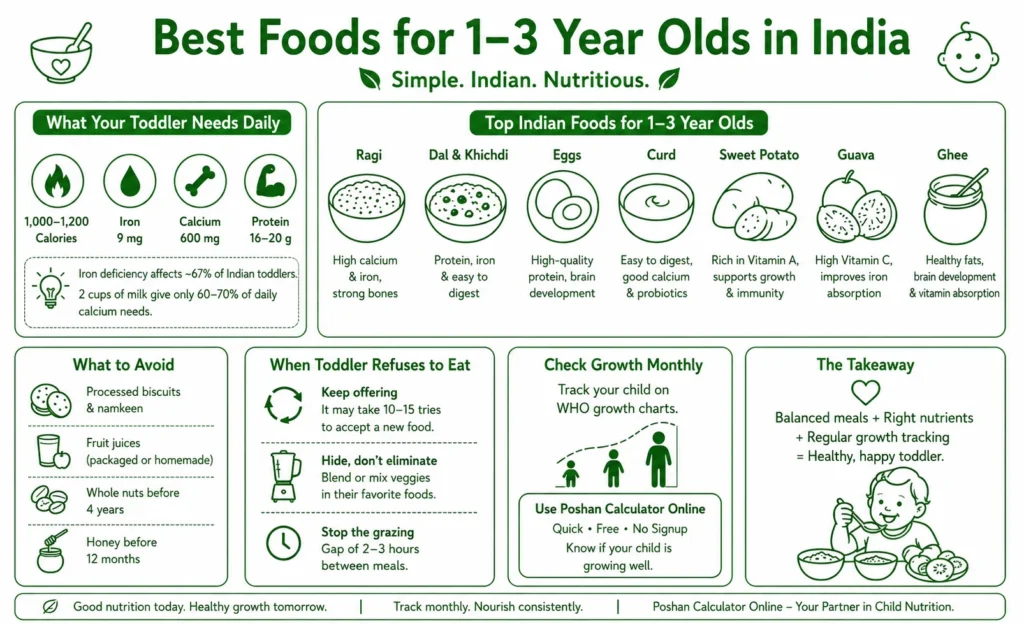
A toddler’s stomach is very small; they eat the food as per their fist size. The children of this age do not need the food which the adults eat. In this aspect, the parents should know the quantity of food that their child needs. The Indian Council of Medical Research (ICMR) recommends roughly 1,000–1,200 calories per day for this age group, with specific targets for iron (9mg), calcium (600mg), and protein (16–20g daily).
Two nutrients are particularly critical in the Indian context. First, iron deficiency affects around 67% of Indian toddlers are anaemic. Second, most parents assume two cups of milk covers the daily requirement, but it actually only gets you about 60–70% of the way there. This is exactly why foods like ragi matter so much in an Indian diet.
The Best Indian Foods for 1–3 Year Olds
Ragi: India’s Most Underrated Toddler Food
If there is one food worth adding to your toddler’s weekly routine right now, it is ragi. Per 100 grams, ragi contains 344mg of calcium more than milk, more than paneer, more than anything else commonly available in Indian cooking. It is also rich in iron, has a low glycaemic index, and is surprisingly easy to prepare.
Ragi porridge with a little jaggery and ghee is a complete breakfast by itself. You can also make ragi dosa, ragi roti, or even ragi ladoos as snacks. Children from the age of 12 months onwards handle it very well.
Ragi is the best food for your toddler. You can give this food to your child throughout the week. The reasons behind this are:
- Per 100 grams, ragi contains 344mg of calcium, which is more than milk.
- It contains more ingredients than the paneer.
- Also, more ingredients are available in the local market foods of India.
Ragi with the desi ghee is a complete breakfast by itself. This food is best for the age of more than 12 months. The use of ragi is to make dosa, roti and ladoos.
Dal and Khichdi: The Classic That Works
Khichdi is a food which is commonly used in India for children and adults who are unwell. The other reason behind this is that it is very easy to cook. This food is best for children of age under 18 months. This food has the best ingredients, for example:
- rice (carbohydrates)
- dal (protein, iron, zinc)
- ghee (healthy fats, fat-soluble vitamin absorption)
In the making process of khichdi, one thing should be added as an extra, which is lemon juice or tomato, as they have Vitamin C, which improves the iron absorption from the food
Eggs: Simplest Protein You Can Offer
Eggs have many benefits and ingredients, such as:
- 6g of high-quality protein
- Choline for brain development
- Vitamin D
- Vitamin B12
Those peoples which eats the egg daily they got these benefits. Eggs can be taken in any it is best for health. According to the American Journal, the children who ate eggs daily have 47% reduction in stroke risk over the other children. The eggs can be taken in any way, they are beneficial for health in scrambled, soft, boiled and in rice or the form of an omelette.
Curd: Better Than Plain Milk for Most Toddlers
Full-fat homemade curd is the best food for toddlers who eat it. The main benefit of this food is that it can be digested very quickly compared to milk. The main benefits of this food are:
- Good amounts of calcium
- Good amounts of protein
- The live probiotic bacteria support gut health
Curd with the rice is the best combination for this age. Curd with mashed banana makes a quick, nutrient-dense snack that most toddlers love.
Sweet Potato: The Vitamin A Fix
Vitamin A deficiency is one of the common issues which are commonly found in the Childrens of India. To fulfil this, sweet potatoes are used for this purpose because, as per the needs of toddlers, half a sweet potato is enough for their daily needs. The other benefits of this are that it is naturally sweet, and it does not need extra sugar. For the children 18 months or older, it can be served in a fried item as finger fish.
Seasonal Fruits: And Why Guava Beats an Orange
Different fruits are seasonal. One of them is the guava fruit, which is very nutritious and grows in India. The guava has more Vitamin C than the orange and can be obtained all year round. Why is Vitamin C considered very significant? Vitamin C plays a key role in the absorption of iron from vegetables. You can have guavas or amlas during iron-containing meals such as dal, ragi, and leafy greens. This way, you will be using nutrition knowledge practically, not just having healthy food habits.
Ghee: Stop Avoiding It
Parents of toddlers have been advised to maintain low-fat diets for their kids. This recommendation is incorrect because the requirement for toddlers 1–3 years old is 35–40% of their calorie intake as fats. The brain continues myelination, covering of nerve cells with a fatty layer, which increases its functions and processes much faster. Fat added to dal, khichdi, or ragi is not luxurious; rather, it plays a functional role here as well. It also helps in fat-soluble vitamin absorption (A, D, E, and K).
What to Actually Avoid (The Short List That Matters)
There are quite a few items on the list of things not to be included. However, here are the top four you need to look out for in the mentioned age category:
- Processed biscuits and namkeen are not good for health because they contain excessive salt, refined flour, and trans fat. They do not have the nutritional values.
- Fruit juices (either packaged or homemade): In this, the actual fibres available in the fruits are lost, which do not give more benefits.
- Whole nuts before the age of four: The pasted nuts or their powder is not helpful.
- Honey before 12 months old: Try to use the honey after 12 months of age in small quantities.
When Your Toddler Refuses to Eat: What Actually Helps
The food refusal issue in children is very common. The reason behind this is not medical. Try to give the child those foods which they eat happily. A few things that genuinely help:
- Keep offering rejected foods without pressure. Research shows most children accept a food after 10–15 exposures. Today’s rejected lauki might be next month’s favourite.
- Hide, don’t eliminate. Blend spinach into dal. Mix moringa powder into ragi porridge. Fold grated carrot into roti dough. The child gets the nutrition; you skip the fight.
- Stop the grazing. A toddler who has been snacking on biscuits all morning will not be hungry at lunch. Structure meals with proper gaps of at least two to three hours between eating occasions.
Is Your Child Actually Growing Well? How to Check
Feeding the right foods is one half of the equation. The other half is knowing whether those foods are translating into healthy growth. You can have the best intentions with every meal and still miss something iron deficiency, for example, is notoriously hard to spot from diet alone because it builds slowly.
The most dependable way is to plot the weights and heights of your child with the WHO growth charts each month. The Poshan Calculator Online offers a quick WHO assessment for nutrition, Weight for Age, Height for Age, and Weight for Height, taking less than two minutes. This service is free, does not require any registration, and informs you in no uncertain terms whether your child falls in the normal category or is starting to develop into stunted, wasted, or underweight child.
The Takeaway
You do not need to overthink this. The best diet for a 1–3-year-old in India is built around foods that have been feeding Indian children well for generations: ragi, dal, curd, eggs, seasonal fruits, leafy greens, and ghee. The key is consistency, variety, and a few smart combinations like iron with Vitamin C.
And alongside feeding well, keep watching the growth numbers. Monthly tracking with Poshan Calculator Online takes two minutes and tells you far more than any food diary ever could. Because good nutrition and good growth go together, and you deserve to see both.