
ICDS vs WHO Standards: Which Does the Poshan Calculator Use and Why?
ICDS vs WHO Standards: Turns out, growth monitoring in India runs on two different rulebooks. The ICDS (Integrated Child Development Services) growth charts, the ones Anganwadi workers typically use, were developed decades ago using Indian reference data. The WHO (World Health Organization) standards, on the other hand, are based on a global study of healthy, breastfed children across multiple countries, and were adopted by India’s own health ministry as the recommended benchmark.
Same child, same measurements, but depending on which chart you’re checking against, the result can look slightly different. That’s exactly why the Poshan Calculator needed to make a clear choice, and why understanding that choice matters more than most parents realize.
That question stayed with me. I’d been using poshancalculatoronline.com for my own son’s growth tracking for a few months by then, and I realized I’d never actually asked what standards the tool was using. I just trusted the color codes. Green meant fine. That was the extent of my analysis.
So I went looking. And the answer to the ICDS vs WHO child growth debate turned out to be more interesting and more practical than I expected.
Quick Answer:
The Poshan Calculator uses WHO Child Growth Standards as its primary reference, the same standards adopted by India’s ICDS and Poshan Abhiyaan programs. WHO and ICDS use the same underlying growth data for children aged 0–6 years. The calculator measures weight for age, height for age, and weight for height simultaneously, giving an instant nutritional status result, Normal, MAM, or SAM, that aligns with both frameworks.
What the ICDS vs WHO Standards Child Growth Comparison Actually Means
Let me tell you what it actually does when you sit down and use poshancalculatoronline.com and see the results come back. The tool asks for your child’s age, sex, height in centimeters, and weight in kilograms. It then runs those numbers against a reference population, a large, carefully selected group of healthy children used to define what “normal” growth looks like at each age.
That reference population is the WHO Multicentre Growth Reference Study, conducted across six countries, including India. ICDS, the Integrated Child Development Services scheme, formally adopted these same WHO Child Growth Standards in 2008. So when an Anganwadi worker plots a dot on a paper chart and when poshancalculatoronline.com calculates your result, they are referencing the same data.
The difference is execution, not standards. One is a dot on a blurry photocopy. The other is an automatic calculation.
What most parents don’t realize: the WHO standards were specifically designed to show how children should grow under optimal conditions, not just how they do grow in a given population. That distinction matters enormously for India, where regional averages include many undernourished children.
How to read Poshan calculator results correctly
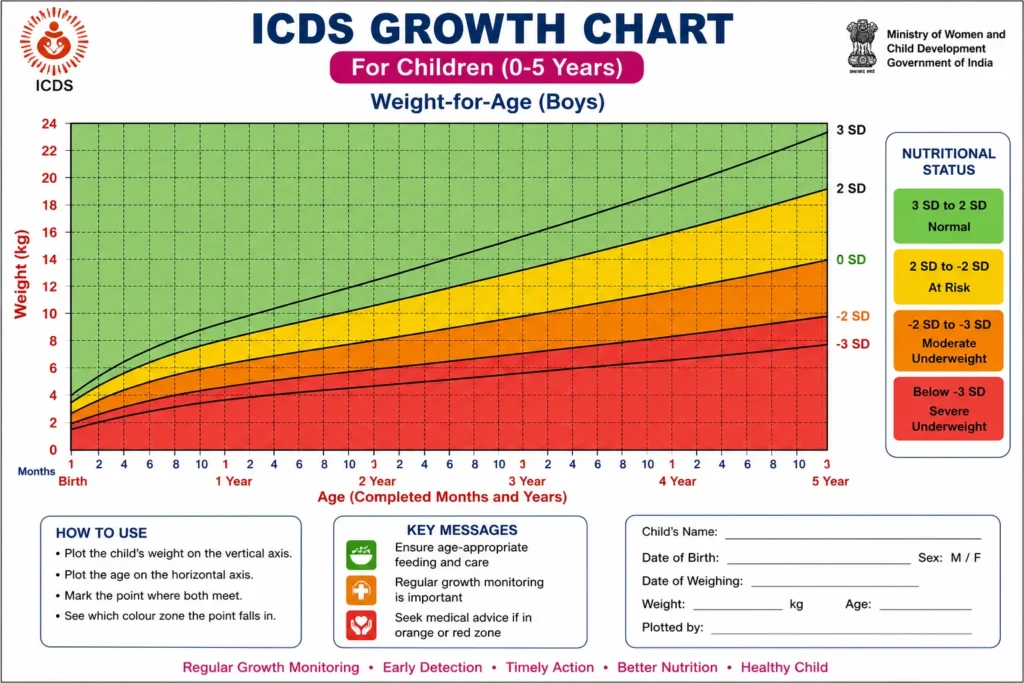
The Reality of Paper ICDS Growth Charts on the Ground
The paper ICDS growth chart is actually, scratch that. Let me describe what I’ve actually seen at our local Anganwadi center in Lucknow. It’s printed on thin paper, folded three times, and stored inside a register that gets carried through rain and dust. The gridlines are fine. The numbers along the axes are small. A dot gets plotted with a ballpoint pen by someone who has seventeen more children to see that morning.
I am not saying this to criticize anyone. The Anganwadi workers I’ve met work under real pressure with almost no support. But the system’s ceiling is low.
A 2020 review published in the Indian Pediatrics journal found significant variability in how growth data was recorded and interpreted across ICDS centers with inconsistency in chart use being one of the primary contributing factors to missed malnutrition cases at the community level.
The paper chart and the Poshan Calculator use the same WHO child growth standards. But one requires a trained hand, good lighting, an undamaged chart, and time. The other requires a phone.
That gap is where children get missed.
How Anganwadi workers can use the Poshan calculator during field visits
Side by Side: What Actually Differs
|
The honest limitation of the digital tool: it cannot verify the measurements you enter. If your weighing scale is off by 400 grams, or your child was measured standing when they should have been measured lying down, the WHO calculation runs on wrong inputs. The result looks clean but means nothing.
That’s a solvable problem; careful measurement fixes it. A smudged paper chart from 2019 is harder to correct.
How to Use It for the First Time
I expected the tool to be more technical than it turned out to be. It isn’t.
- Open any browser on your phone and go to poshancalculatoronline.com no login, no account.
- Select your child’s sex. WHO Child Growth Standards differ between boys and girls.
- Enter the date of birth exactly. The tool calculates the precise age in months automatically.
- For children under 24 months, measure lying down (recumbent length). For children over 24 months, measure standing height. These are not interchangeable WHO standards treat them as different measurements.
- Remove shoes and heavy clothing before weighing. Enter weight in kilograms only.
- Click Show Results and check all three indicators, not just the overall color.
The tip most parents miss: note your results before closing the page. The tool does not save previous entries. Navigate away, and the calculation disappears.
The whole process takes less time than waiting for the Anganwadi register to be found.
Reading Your Results Without Panicking
Green means Normal
Your child’s weight for age, height for age, and weight for height all fall within WHO healthy ranges. Continue current feeding practices and recheck every one to three months.
Yellow means MAM: Moderate Acute Malnutrition
This needs attention. Visit your Anganwadi center or pediatrician within two weeks. ICDS supplementary nutrition programs are specifically designed for this category.
Red means SAM: Severe Acute Malnutrition
Act now. SAM requires immediate medical assessment and likely referral to a Nutrition Rehabilitation Center. Do not wait to see if it improves on its own.
Orange means Overweight
Increasingly common in urban and semi-urban areas. Discuss with a doctor the cause matters before making any dietary changes.
And this is the part that changes how you think about it. A child can show green on weight for age while showing yellow on weight for height that’s wasting, a different and more urgent condition than the overall color suggested. Checking all three indicators from the WHO and ICDS framework together is the only way to catch what a single number misses.
Understanding SAM and MAM — what Indian parents should do next
Errors Nobody Warns You About
Mixing up length and height
Children under 24 months are measured lying down, which is called recumbent length. Children over 24 months stand at that height. The WHO growth standards include a 0.7 cm correction factor between the two. Select the wrong position on the tool, and your height-for-age reading shifts systematically wrong every single time.
Entering age as an estimate
If your child is 14 months and 18 days old and you enter “14 months,” you’re close but not exact. poshancalculatoronline.com calculates from the date of birth automatically use that field. Let the tool do the math.
Weighing with a diaper and winter clothes on
This sounds minor. It is not. A heavy diaper, sweater, and shoes together add 500–800 grams. For a child already near the MAM threshold, that weight shifts the result from yellow to green, hiding a real concern.
Reading only the overall status color
The tool gives three separate indicators. Some parents see “Normal” in the headline color and close the page. But one of the three underlying indicators might be yellow. The detail section below the main result is where the actual information lives.
Real Questions, Straight Answers
Final Thoughts:
My neighbor’s daughter was checked again this time properly, with exact measurements and the Poshan calculator at home. She came back green on two indicators, yellow on one. That yellow led to a conversation with a pediatrician that would not have happened otherwise.
“Probably fine” is a guess. “Yellow on weight for height” is information.
If the ICDS vs WHO child growth question brought you here, the short answer is: the Poshan Calculator uses both, because they are the same standard applied the same way. What differs is the precision you bring to it.
Open poshancalculatoronline.com with your child’s measurements ready. Check all three indicators. Save the result.
Know the number. Then act on it.