
My Child Is Underweight: A Parent’s Complete Guide
Here’s what actually confuses most parents at that 15-month checkup: “underweight” isn’t one single category; it’s a spectrum. A doctor might flag mild MAM (Moderate Acute Malnutrition) that clears up with a few weeks of better feeding, or something closer to SAM (Severe Acute Malnutrition) that needs closer monitoring.
The word on its own doesn’t tell you which one you’re dealing with, and that’s exactly the gap that leaves parents Googling at midnight instead of acting with a clear next step. Running the same height, weight, and age through the Poshan Calculator gives you that missing context instantly, so you know whether you’re looking at a small dietary tweak or something that needs a doctor’s follow-up sooner rather than later.
Most Indian parents discover their child is underweight at a routine checkup, not because they noticed something wrong. And that gap between “looks fine” and “actually fine” is exactly what this guide is about.
Mostly, parents do not know their child is underweight; they get that after the proper checkup from the doctor. It means that no one can judge by appearance; they can judge after a complete checkup.
Quick Answer:
If your child is underweight, check their nutritional status immediately using a free tool like the Poshan Calculator. It gives instant results based on WHO and ICDS standards. Then increase meal frequency, add calorie-dense Indian foods like dal with ghee, eggs, and ragi, and consult a doctor if the result shows MAM or SAM. Start today, not next week.
What “Underweight” Actually Means on a Growth Chart
Here’s the thing: skinny and underweight are not the same thing. Some children are naturally lean and tracking perfectly on their growth curve. Others look average but are quietly falling behind.
The clinical definition uses WHO growth standards specifically, weight-for-age and weight-for-height measurements plotted against a reference population. When a child’s score falls more than 2 standard deviations below the median, they’re classified as underweight. Below minus three is severe.
What this means practically: a child can be eating three meals a day, seem active, and still be undernourished if those meals aren’t delivering enough calories, protein, and micronutrients.
The fastest way to find out where your child actually stands, not guess, not compare to cousins, is to use the Poshan Calculator at poshancalculatoronline.com. Enter age, height, and weight. Get an instant result aligned with ICDS and WHO benchmarks. It takes ninety seconds, and it’s free.
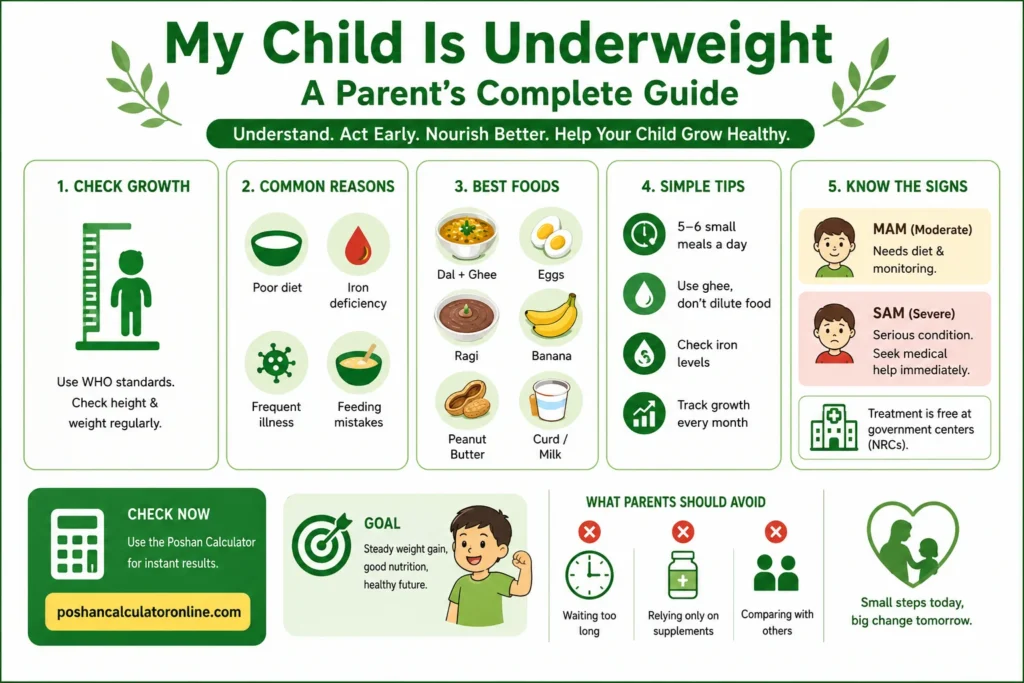
The Real Reasons Indian Children Fall Behind in Weight
It’s rarely one thing. That’s what makes it frustrating.
The most common cause is a calorie gap: in most cases, the energy intake does not match their age, size, and activity level. Mostly, the food provided to the children is a large bowl of thin dal with rice, which doesn’t fulfill the energy requirements of children. A growing child of more than two years needs around 1000-1200 calories a day; these foods do not fulfill the requirement.
Iron deficiency is the second main reason behind the underweight of children. Because iron deficiency kills appetite. If it kills the appetite, it means the child will not take a proper diet due to no appetite, which in result causes weight loss in the child.
The third reason behind weight loss is frequent illness, which burns the nutritional values in the child. The children who get diarrheal illness or respiratory infections will lose weight, and they remain in a struggle to catch up.
And honestly? Complementary feeding mistakes are huge. Transitioning from breastmilk to thin khichdi or diluted dal pani feels like “proper food” but often delivers a fraction of the calories the child needs. The timing of that transition and what’s in the food matters more than most parents realise.
Best Indian Foods for Underweight Children: The Practical List
Most articles on this topic list quinoa and Greek yogurt. I’ve never understood that. Let’s talk about what’s actually in Indian kitchens.
Dal and legumes are your foundation
The dal is a protein-rich food that is available at cheap rates in every store. If you add a teaspoon of desi ghee to it when you are serving it to the child. The calorie deficiency in their food is filled with this ghee, without changing the taste of their food.
Eggs have a very important nutritional effect on child growth. If a family eats eggs, it has a measurable effect on their life. They can take eggs in the form of boiled, scrambled, or in a paratha.
Ragi needs more recognition than it is getting. Ragi is richer in calcium and iron than most other cereals. Ragi porridge is easily digestible and can be used for infants. If you have not yet tried ragi, you may try it here.
Banana with ghee. Peanut butter, if available. Full-fat curd or milk daily is always full-fat for children under five, because the fat is part of the nutrition, not an extra.
I grew up eating ragi mudde in Karnataka and somehow forgot it was a thing until my own child’s dietitian brought it up. Funny how that works. Anyway, the point is, the foods that help are the ones your grandmother probably already knew about.
How to Track Your Child’s Growth at Home: Free
You don’t need a clinic appointment every month. You need a digital scale, a wall, a measuring tape, and ten minutes.
Weigh in the morning before food. Measure height against a flat wall, heels together, no shoes. Enter both numbers plus age into the Poshan Calculator at poshancalculatoronline.com. Write the result down, actually write it, not just a screenshot, you’ll lose in three weeks.
Do this monthly. What you’re tracking isn’t the number itself. You’re tracking the direction. Consistent upward movement, even slow, means things are working. Flat weight for six weeks or more means something needs to change.
Actually, scratch that. What I mean is: if the weight has been flat and your child is already borderline, don’t wait the full two months. Six weeks of no movement is your cue. Go sooner.
MAM and SAM: When It Gets Serious
MAM is Moderate Acute Malnutrition. Weight-for-height is significantly low. Needs dietary intervention, needs monitoring, but is manageable at home with the right support.
SAM Severe Acute Malnutrition is different. The risk level jumps significantly. Children with SAM face higher rates of illness, developmental delay, and, in untreated cases, far worse outcomes.
SAM treatment is free in India. Nutrition Rehabilitation Centers run under POSHAN Abhiyan provide inpatient and outpatient treatment at no cost. You do not need money. You need to know where to go.
If the Poshan Calculator returns a SAM result, go to your nearest government hospital or Anganwadi center that same day. Ask specifically for an NRC referral. Don’t wait.
Moves That Actually Work: Tips From Parents Who’ve Been There
1. Switch From Three Meals to Five or Six
Due to the smaller size of the stomach, there is also less capacity to take in more food. This means that having snacks in the middle of the day is recommended. Some good snacks would be bananas, curd, eggs, and some bread with butter.
2. Stop Diluting Everything
Thin dal, watery khichdi, and over-diluted milk fill up a small stomach fast and deliver very little. Thicker is better. More ghee is better. Full-fat always.
3. Fix Iron Before Fixing Diet
Poor appetite that doesn’t respond to food changes is often iron deficiency. Ask your paediatrician for a haemoglobin check. If iron is low, treating it first unlocks appetite and then the dietary work actually lands.
4. Make the Poshan Calculator a Monthly Habit
Set a reminder. First Sunday of every month, ten minutes, done. Parents who track consistently catch problems early. Parents who eyeball it miss things for months.
5. Don’t Aim for Fast Weight Gain
Rapid weight gain in children can be as problematic as slow. Steady, consistent monthly gains are the goal. Patience is part of the strategy here, the boring, necessary kind.
What Most Parents Get Wrong: And Why It Stalls Progress
Waiting to See If They Grow Out of It
Some do. But the 0–3 window for brain development and physical growth doesn’t wait. Spending a year hoping is a year of that window closing. Don’t gamble with it.
Relying on Supplements Over Food
Nutrition syrups and powders are supplemental; the word is right there in the name. They don’t fix a food problem. They add a little on top of a food foundation. If the foundation isn’t there, the supplement isn’t doing much.
Compared to Siblings or Relatives
“Her older brother was the same, and he’s fine now.” Growth patterns vary significantly between children. Your reference point has to be the growth chart, not family anecdote. The chart doesn’t have confirmation bias. People do.
Only Checking at Doctor Visits
Three or four months between checkups is too long when you’re trying to improve your nutritional status. Home tracking is free, fast, and gives you data between appointments when it matters most.